What Nike Tech Uniforms Are Really About: Understanding Youth Culture as Leadership Strategy
Learn how understanding youth culture signals—like the significance of Nike Tech uniforms—can transform your approach to youth leadership and engagement.
 PCS Consultant6 min read
Last year, I was walking through the halls of a high school in Queens when I noticed something that stopped me cold.
Three young men. Same Nike Tech fleece. Same grey color. Same fitted cap. Walking together like they were in formation.
The principal next to me shook his head. "I don't get it. Why do they all have to dress the same? It's like they can't think for themselves."
I watched those students for another moment. Then I turned to him.
"You're asking the wrong question," I said. "You're seeing conformity. They're performing belonging."
He looked confused.
So I explained something that changed how he saw student behavior forever.
These young people aren't mindless followers. They're navigating one of the most complex social experiments in human history: building identity in the age of social media.
And if we don't understand that, we'll never connect with them.
The Conversation I Had to Have with Myself
When I was deputy superintendent, I used to get frustrated by the same things.
Why were students so focused on clothes? Why did trends matter so much? Why couldn't they just focus on academics instead of worrying about looking cool?
Then one day, I was prepping for a speech at a conference. I pulled out the outfit I'd planned—dark jeans, a blazer, fresh sneakers.
My wife looked at me. "You wore that exact outfit to the last conference."
She was right. I had a uniform. Business casual with a street edge. Not because I couldn't think for myself. But because I knew exactly the image I wanted to project.
Professional, but approachable. Educated, but still connected to where I came from.
I was doing the exact same thing I was criticizing students for.
And that's when it clicked: Young people dressing alike isn't about copying each other. It's about communicating belonging in a world where belonging is constantly under threat.
What We're Actually Looking At
When I see students wearing matching Nike Techs, I'm not seeing kids who lack individuality.
I'm seeing young people who figured out a social code.
Here's what adults miss: Fashion has always been a language. But for this generation, it's a language spoken in real time, across platforms, with consequences that didn't exist when we were their age.
When I was seventeen, if I showed up to school in the wrong outfit, maybe ten people noticed. I'd take the L for a day, switch it up tomorrow, and move on.
Today? A student posts a fit check on Instagram before leaving the house. Two hundred people have an opinion before first period. One wrong move and you're a meme by lunch.
The stakes are different now.
So when students dress alike, they're not being lazy. They're being strategic. They've figured out that certain brands, certain colors, certain combinations signal: "I belong. I'm in. I'm not the outsider."
It's social armor.
And when I understood that, I stopped seeing conformity and started seeing survival.
The Student Who Taught Me This
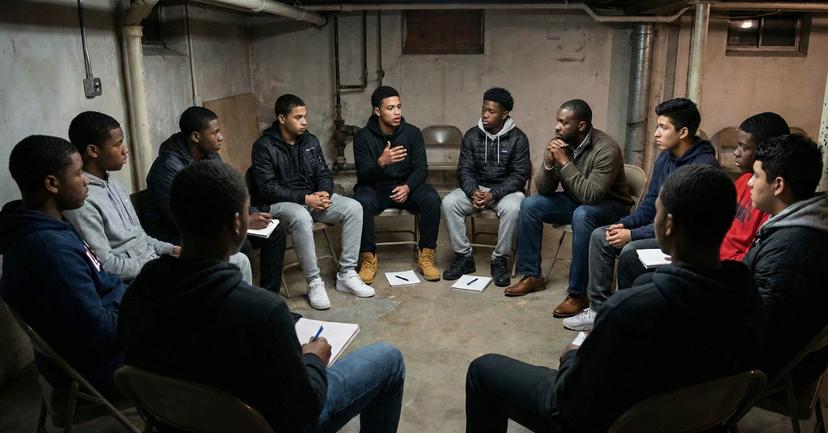
A few years ago, I was running a My Brother's Keeper session with a group of young men. One of them, Darnell, showed up every week in the same Nike Tech hoodie. Grey. Fitted. Always fresh.
During one session, we were talking about confidence. I asked him, "Darnell, when do you feel most confident?"
He thought about it. "When I'm wearing this," he said, gesturing to his hoodie. "I know I look right. So I can focus on everything else."
I asked him to explain more.
He said, "If I show up looking wrong, I'm already behind. People judge you before you even say anything. But if my fit is right, I can walk into any room and know I'm good."
That hit me differently.
Because what Darnell was describing wasn't vanity. It was emotional bandwidth management.
He had limited energy to navigate a world that was already judging him for being young, Black, and male. If dressing a certain way removed one layer of social anxiety, that was a smart move. That freed up mental space for the things that actually mattered—learning, connecting, growing.
What Adults Get Wrong About Trends
Here's what I tell educators when they complain about student fashion:
"You're seeing the surface. You're missing the strategy."
When you were a teenager, you did the same thing. You just had different tools.
In the '90s, it was baggy jeans and Timberlands. In the 2000s, it was fitted caps and throwback jerseys. Every generation has its uniform. Every generation uses fashion to communicate identity.
The difference now? The scrutiny is constant. The feedback is instant. And the consequences of getting it wrong are amplified by algorithms.
So when you see students wearing matching outfits, here's what's actually happening:
They're reducing decision fatigue in a world that demands infinite choices.
They're creating visual cohesion in a culture that celebrates belonging.
They're controlling one of the few things they can control in an environment where so much is out of their hands.
That's not weakness. That's strategy.
The Shift That Changes Everything
So what changed when I started seeing student fashion as communication instead of distraction?
Everything.
Instead of dismissing students for caring about their appearance, I started asking them what their clothes meant to them.
Instead of banning certain brands or styles, I started conversations about identity, belonging, and self-expression.
Instead of making assumptions about their values, I listened to what they were actually telling me through their choices.
And you know what happened?
They opened up.
Because for the first time, an adult wasn't judging them for caring about fashion. An adult was curious about what fashion meant to them.
One student told me, "When I dress like this, people see me differently. Teachers don't assume I'm trouble. Security doesn't watch me as much."
Another said, "My fit is the one thing I can control. My home life is chaotic. School is stressful. But this? This is mine."
Another: "When we all dress the same, it's like we're a team. We got each other's backs."
These weren't shallow kids obsessed with materialism.
These were young people using the tools they had to navigate a world that doesn't make space for them.
The Bigger Conversation We're Avoiding
Here's the uncomfortable truth:
We judge students for conforming to fashion trends while we demand they conform to academic structures designed fifty years ago.
We criticize them for caring about image while we grade them based on how well they sit still and follow directions.
We tell them to "be yourself" while punishing any deviation from what we consider appropriate.
The contradiction is glaring.
And young people see it.
They see us policing their self-expression while claiming we want them to think independently.
So when I work with schools on student engagement, one of the first things I do is challenge educators to stop seeing student culture as a problem and start seeing it as a window into how young people make sense of the world.
Because if you can't respect how they express themselves, you'll never earn the right to speak into how they see themselves.
The Bottom Line
Those three students in matching Nike Techs? They weren't conforming. They were connecting.
They were saying, "We see each other. We're in this together. We belong."
And honestly? That's beautiful.
Because in a world that constantly tells young people—especially young men of color—that they don't belong, finding ways to create belonging is an act of resistance.
So here's my question: What are you seeing as conformity that's actually communication? And what would change if you started listening?
About the Author

Related Articles


Subscribe to Our Newsletter
Get the latest insights on youth leadership, education consulting, mentorship, and AI in education delivered to your inbox.